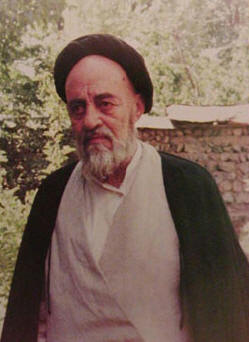
A lot of scientists are still sceptical about philosophy, because they don’t understand what is taught, because it’s not an exact science. And that while philosophy is so important, it helps you to understand religion and politics and helps you to come to terms with scientific theories like the big bang. Tabataba’i is a philosopher exegete and believes philosophy is essential for educated believers. Your faith can be a threat by scientific claims and Tabataba’i offers you a way out when facing these threatening challenges.
Tabataba’i attempted to revive philosophy. He was influenced by Ibn Arabi’s mystical dimension thoughts; he liked transcendental philosophy. His philosophy gives a critique on materialism and secularism and he gave a demonstration on doing metaphysics. He sets a vision that is hidden from materialists and which gives disclosure. In the world there are realities that aren’t visible, and they need to be grasped mentally and intellectually.
He gives us a homology approach; think in simultaneous modes through philosophy. You need a legal mystical theological outlook that doesn’t separate things but reinforce each other. He applies this method in his writings. He works in line with Henry Corbin.
Philosophy is universal, but sometimes it’s different coloured because it’s localised in different cultures.
Before you read scriptures, you need to be philosophically trained. Otherwise you unfairly claim authority for reading texts which can be very dangerous. Trained philosophers can see the value in universal scripture. Scripture is a communication between god and humans, it’s a bridge for rational agents for coming to know immaterial realities; the world of metaphysics.
Tabataba’I was like Avicenna sublime in summarising philosophical writings. He summarised text from Aristotle to Mulla Sadra Shirazi, which takes up a period for over 2000 years. And all that was summarised in a book of 150 pages.
Before understanding all the difficult works of philosophers, you have to undergo a philosophical awakening. Many reflective moments are ignored. He talks about the fact that it’s indubitable that we exist. Even doubt is a sign of existing. When you doubt you must acknowledge that you exist. Doubts triggers a moment in awakening which cannot be mediated by anything else. When you acknowledge reality is indubitable, you passed the first step.
Now, why do we take this step? Well, existence subsumes everything and is the highest category. Existence is predicated of its instances. When you talk about things you affirm that they are or that they are not. When they are not, they lack existence. When we talk about existence we don’t define it by a property, we reflect. The virtue of existence allows things to be what they are and gives things excellence. He applies a univocal predication; there’s one meaning of existence, there’s just one interpretation.
Tabataba’I talks about mental and real existence. For everything in the world, there’s human engagement. When we talk about a flower it has reality by itself, when we try to understand it, there’s a different modality; the essence is not maintained. The mind only finds its correspondence. In the mind there’s only the concept of the flower. The true essence is outside the mind.
Everything is an instantiation and particularisation of existence. Existence unfolds itself in different ways. There are just different degrees.
Existence has an ontological priority and is more fundamental than essence. Identified essences exist alongside existence. Essence cannot exist by itself.
Avicenna and Al-Farabi claimed that when we take person A, its existence comes first. Illuminists said properties are prior; essences come before existence. Tabataba’I denies that your essence doesn’t make you human, it’s existence that comes before essence.
Essence can’t bring itself into existence. Inside essence there must be something that exist before it which allows quiddity to come into reality and this must be an extrinsic being. What breaks down existence and non-existence is existing itself. And essences are responsible for bringing diversity into the world. We wouldn’t have a unity when essences would be prior. Existence is more universal and therefore fundamentally prior.
Tabataba’I also claims knowledge is an extension of ontology. It’s self-evident, when we learn more, we become more intense ontologically. When knowledge becomes a mode of existence, it becomes a way to participle in existence and increase human existence.
When we know something, we affirm or deny existence. In knowing an answer to a question, you affirm existence to it. So, knowledge is closely linked to existence.
In knowledge by presence we attach to immediacy. Nothing outside the human self is needed. For studying medicines you need external things, but for self-referential knowledge you don’t need things outside you. You have presence of it in the mind.
Given concepts themselves are metaphysical. We seem to know them immediately without material tools. Knowledge of immaterials is very well possible.
 Juliette's blog