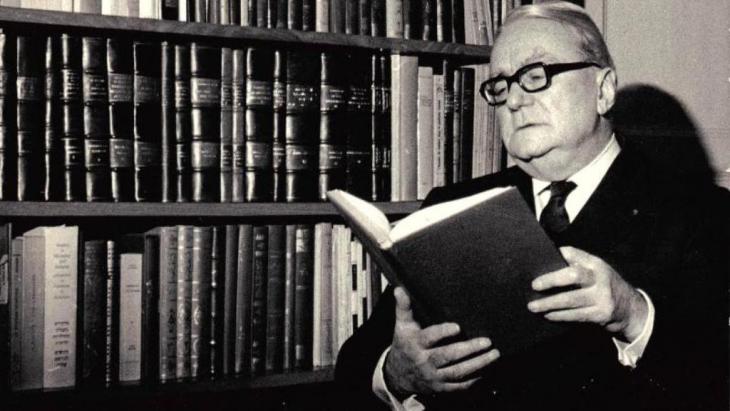
Arabic philosophy fits in the modern period and is still thriving. Some people think Arabic philosophy died with Al Ghazali’s attack on philosophers.
Henry Corbin claimed European studies impoverished. Many thinkers lack Arabic, they can’t read or access the texts. So, in the European world there wasn’t enough information about philosophers after Avicenna. This is tragic, since there has been a Persian Islamic renaissance. We keep talking about philosophers like Descartes while there were philosophers so much steps further ahead during the same time, like Mir Damad and Baha al-Din Amili. Corbin took part of the Isfahan school which contained a philosophical and mystical movement.
He used two approaches towards Arabic philosophy.
First, he invited the philosophy as wisdom about the human world and nature. He makes an important distinction with modern Arabic philosophy. He talks about rational and supra-rational. The philosophy is mystical as well as rational. Taste and emotion are used for mysticism. It’s a prophetic philosophy and a way of life, because within the journey you search for inner guiding principles of wisdom while reflecting on the world. So, for the inner search, philosophy is used.
Second, Corbin applies hermeneutics for reading texts. Meaning that by reading you seek to find different philosophical layers within the text; unveil the hidden. Often philosophical truths are hidden, when we can’t make sense of a text we’ve used the wrong techniques.
For example, a young child who doesn’t understand the function of bike yet, the idea of it was still concealed, now the child undergoes training and unveils the bike’s functioning.
An important aim of philosophy is to disclose the essence of texts. Language is needed when we have an essential truth, but at the same time language is a barrier between the subject and essential truth. Philosophy is an act of unveiling where language needs to be disclosed.
Dimitri Gutas is Corbin’s opponent. He thinks Corbin is obscuring Arabic philosophy and accuses him of reducing the Islam to a singular essence. Gutas thinks philosophy in the Islam isn’t mystical and rooted in spirituality. He warns us against reductionism. Gutas engages in nativism. Moreover, Gutas believes it’s false to assume as tension between mysticism and reason. This tension doesn’t always exist, at least not for Avicenna and Al-Farabi.
Corbin and Gutas have opposing views about how Arabic philosophy is seen, both have dominating views.
 Juliette's blog