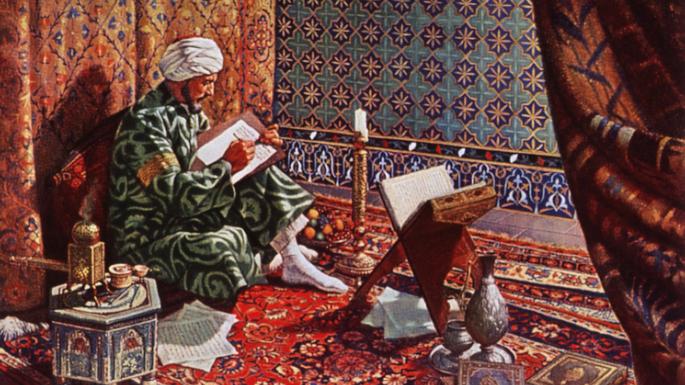
Avicenna introduced a new chapter in philosophy. He didn’t continue the path of Aristotelean philosophy. He became a dominant figure. He diverges in Islamic thought. What’s impressive is that he gives a combination of 2000 years of philosophical activity, explained and clarified. By systemising, ingredients are used to form a new tradition. This led to a coherent worldview where many people believed in.
Aristotle sees the soul as a first perfection of a natural body, it’s a completion. He believed that every matter needs a form to exist. All objects in the world contain matter and form. He divides the soul into three parts. Firstly, the vegetative part which is about self-nutrition, growth and reproduction. Secondly, the animal part; the addition of perception and voluntary motion. Thirdly, the human; the addition of rational cognition and action. According to Aristotle, the soul has always been one, just the propensity has changed.
Avicenna critiques Aristotle his theory. There’s a discrepancy, does the soul only operates when it’s in the body? The soul only seems to operate when it’s in the body. That would explain that the soul cares about the bodily functions. This seems to deny dualism. The second problem is the question if human intellectual capacity necessarily entails immateriality. If thinking would be separate from the body, then what is the role of the body in human thinking? The third problem is the location of the soul. Why is in a specific body and not in the other and where in the body does it function? The idea of the soul lead to monopsychism; that all aggregates are of one singular soul. Like there’s a super computer that access to all in the world.
Gladly, Avicenna comes up with solution. What counts for your persuasion and mental states are not the body, because we all have a body with some functions. So, there must be something extra bodily which isn’t necessarily attached to the body. It’s not necessary that the body animates itself. The body commands to live. Wilful decisions can’t generate themselves. Just like a bowl that can’t let it self-roll. Only an action that carries a will must be because of immaterial substance. The living human being can’t live without body and soul. But then if the human essence isn’t the soul, why does it need a body in the first place?
There’s a co-dependent relationship between the soul and body. The body needs the soul to tame it and to instruct to keep the body healthy. The soul needs to grow. The soul is like a hard drive that needs a computer to program it. It acquires intelligible through learning. Therefore, the soul needs the body, the soul isn’t the body.
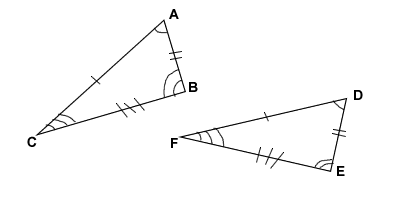
What makes you, you? There’s a multiplicity of souls. To account for exclusiveness, you need spatial temporality. The soul is in a certain space; the body. Take for example two identical triangles, the space and temporality make them different. The multiple souls have all different experiences. They started the same, compare for example water in different bottles. It’s through learning that you become more intense as a human being. All in all, the soul requires the body to become an individual.
According to Avicenna, the soul has 5 internal senses. 1: The common sense; the reception of forms. It explains how you come to know things, you receive forms as data and you remember. 2: The imagery imprinted in the soul. Like the form water remains. It’s about the retention of forms. 3: The estimation; the reception of meanings; how you assign meaning to a form (e.g. The bottle). 4: memory; the retention of meaning. 5: imagination; the separation and combination of forms and meanings.
 Juliette's blog